
The intervention of the Consulate of México in Philadelphia proved decisive in the return of 156 pieces from Teotihuacán that had been held in the university’s collections since the 1960s
By HOY en Delaware
The sound of the “atecolli” (conch-shell trumpet) resonated through the Gilberto Owen Gallery at the Consulate of México in Philadelphia on November 16, as dancers from the group Cenzontle Cuicatl performed the “Corn Ceremony” before a delegation from Pennsylvania State University and the assembled audience.
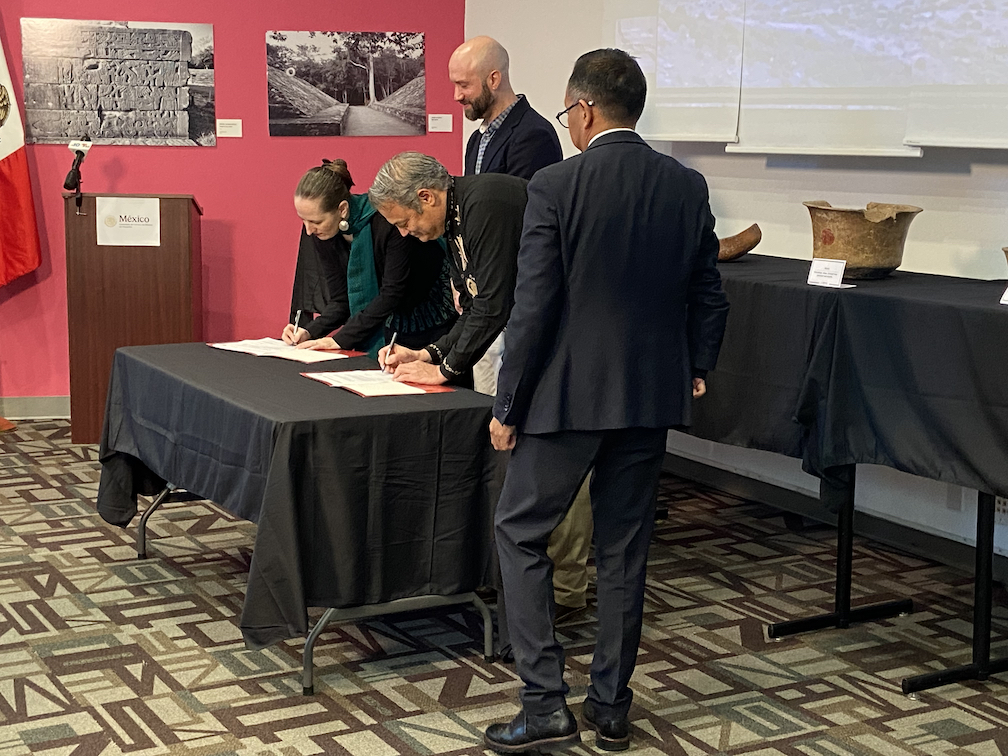
This ceremony of gratitude was just one part of a historic event that took place at the consulate: the signing of an official handover document for 156 archaeological artifacts between Pennsylvania State University and the Government of México, represented by Carlos Obrador, the Cónsul of México in Philadelphia.
The returned items—consisting primarily of fragments of plates, vessels, containers, incense burners, braziers, and sculptures—originated from the university’s “Teotihuacán Valley Project” and were collected in México during the 1960s by the renowned archaeologist Dr. William Sanders (1926–2008).
The project contributed to a more detailed understanding of the growth of Teotihuacán and its surrounding areas, as well as the identification of civic and residential structures within this urban center.
Teotihuacán, which stretching approximately 22 square kilometers and reached a population of between 100,000 and 200,000 inhabitants at its peak, is considered one of the largest and best-planned pre-Columbian metropolises. Known to the Mexica (Aztec) people as “the place where the gods were born,” the Teotihuacán culture flourished from 150 B.C. to 750 A.D. The Teotihuacán archaeological site was designated a UNESCO World Heritage Site in 1987.
The audience had the opportunity to immerse themselves in both the Teotihuacán of the past and the present through the documentary “Land and Water Revisited”—a reimagining of the classic 1962 anthropological documentary “Land and Water”. Filmed in México’s Teotihuacán Valley, this new work revisits many scenes from the original film to highlight environmental changes driven by unchecked urban development and global climate change.
Attendees were also able to view a selection of the repatriated artifacts, all of which had been in the care of the Department of Anthropology at Pennsylvania State University for over sixty years.
During the ceremony, Cónsul Obrador underscored Mexico’s commitment to recovering its cultural heritage from abroad—an initiative led by the Mexican government, with support from the National Institute of Anthropology and History (INAH) and the Ministry of Foreign Affairs, alongside Mexico’s embassies and consulates worldwide.
The Mexican diplomat noted that the repatriation of these items was made possible through the excellent collaboration between the Mexican Consulate and the Penn State Department of Anthropology. These pieces—joined by twenty-two others from a private collection recovered in 2024—bring the total number of artifacts returned during the administration of Claudia Sheinbaum Pardo to 5,733.
“…These archaeological pieces are returning home after spending more than fifty years in the United States,” the Mexican consul remarked.
This milestone was achieved through the development and implementation of protocols, legal strategies, and awareness campaigns by the federal government—efforts spearheaded internationally under the leadership of Foreign Affairs official Roberto Velasco Álvarez. “The irreplaceable collections from the Teotihuacán Valley Project have been fundamental to archaeological research and education for decades, and they will continue to be so for future generations of students in Mexico who are investigating why and how the city of Teotihuacán developed,” noted Dr. Mary K. Shenk, professor and head of the Department of Anthropology at Penn State University, who signed the handover document for the artifacts on behalf of the university.
Rubén Chico, of Cenzontle Cuicatl, also expressed his joy that these and other artifacts are returning to their place of origin, thereby preserving cultural identity and restoring national heritage to its original communities.
The Teotihuacán culture spanned approximately from 150 BC to 750 AD. The Teotihuacán archaeological site was declared a UNESCO World Heritage Site in 1987.
The physical transfer of the 156 archaeological artifacts to Mexico will take place in the coming days.