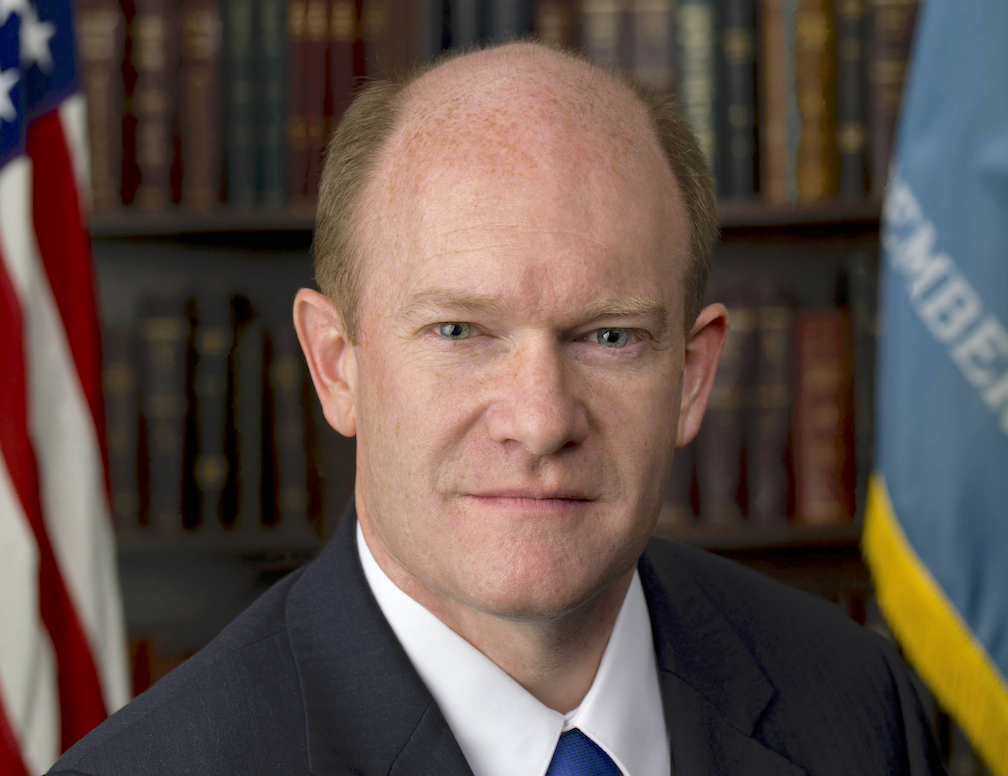

Source: Sen. Coons’ Office
“Religious freedom, as I’ve said, is a fundamental threat to authoritarianism, and it is because of our commitment to a freedom of faith that we are also, as a nation, committed to an equality of all.”
WASHINGTON – U.S. Senator Chris Coons (D-Del.) delivered the closing remarks Tuesday at the Center for American Progress for the launch of “Religious Liberty For All: Celebrating This Founding Freedom at America 250,” a new joint report from the Center for American Progress, Americans United for Separation of Church and State, Interfaith Alliance, and the American Humanist Association. The report, which includes a brief essay from Senator Coons, reflects on what religious liberty means in the lives of many Americans and makes the case for a vision of religious liberty rooted in dignity, pluralism, and the Constitution.
In his remarks, Senator Coons celebrated religious liberty as one of America’s founding freedoms while warning that attacks on freedom of conscience, worship, and expression – whether around the world or here in America – are inseparable from the rise of authoritarianism.
“We are a nation founded on religious liberty, a nation where so many millions came from other places, where there was an established state religion, where refusing to participate in it, or contribute to it, or support it, or name your children according to its conventions, was cause for literal physical repression, imprisonment, or marginalization. We were founded by those who were seeking to practice in good conscience and independence of government control, but not uniformly,” said Senator Coons.
Senator Coons also reflected on Delaware’s long history of religious pluralism, abolition, and faith-driven movements for justice, including the role of Quakers and the Underground Railroad in helping more than 2,000 people escape slavery.
“Whether in a church, a mosque, a temple, at home, in the civic space, in speaking and writing, and thinking, and praying, the ways in which Americans have engaged with conscience and ethics has also driven political change in fundamental ways,” said Senator Coons.
Senator Coons also pushed back on rising Christian nationalism in the current administration and its leaders’ false claim that America is a white Christian nation, pointing tocomments from founding fathers like George Washington and John Adams to modern presidents like Ronald Reagan.
“In my view, my faith is in no way harmed or threatened by those who are humanists, or agnostics, or atheists, or practitioners of any other faith. In fact, it is strengthened,” said Senator Coons. “I happen to be a believing, practicing Christian, but I also represent a million people, and I am really clear that the million people I serve and who hired me include lots of people of goodwill, who do not practice faith and don’t want me talking about it, and I try to balance that.”
Senator Coons concluded by urging Americans to defend religious liberty as essential to democracy itself.
“I think freedom of religion is among those most basic and eternal. And I think when we fail to remember that and to give it life, and purpose, and meaning, we no longer deserve the freedoms for which our forebears fought. To defend our nation and what it means is to defend religious freedom. To defend our Constitution is to defend religious freedom. To defend religious freedom is to defend ourselves, our future, and our very republic,” said Senator Coons.
If you can watch the Senator Coons’ remarks you can WATCH HERE
Transcript of Senator Coons’ remarks:
SENATOR COONS: “Thank you to everyonewho’s been on the panels today and thank you in particular for “Religious Liberty for All,” a report that I actually genuinely enjoyed reading. Senators do still occasionally read. And I’m just going to give you an early warning, the vote on the War Powers Act resolution just got called, so since it’s going to pass or fail by one vote, it is not a lack of enthusiasm for hanging out and talking and reconnecting, but if they go, you got to go, I got to go, because this is one we might actually pass. I’d like to give a lot of credit to Tim Kaine, a dear friend and colleague, who has been relentless and persistent in advocating for peace and for congress to reassert its role.
So, thanks to CAP and to everybody who’s helped make this report possible, and to everybody who’s spoken today. I’m just going to conclude with what I think – I hope – are simple observations, but in a current context where it always bears repeating.
In 1790, President Washington wrote a letter to the Hebrew Congregation of Newport, probably cited earlier today: “The government of the United States, which gives to bigotry no sanction, to persecution no assistance, requires only that they who live under its protection, should demean themselves as good citizens.”
We are a nation founded on religious liberty, a nation where so many millions came from other places, where there was an established state religion, where refusing to participate in it, or contribute to it, or support it, or name your children according to its conventions, was cause for literal physical repression, imprisonment, or marginalization. We were founded by those who were seeking to practice in good conscience and independence of government control, but not uniformly. Obviously, there were different foundings in different places, and the Mayflower Bay Colony had a different vision. Georgia had a different vision. Rhode Island had a different vision. Pennsylvania, just north of me – of the state of Delaware – had a different vision. But the very small town of Hockessin, Delaware, where I grew up, if I just looked around and if I watched it develop over the decades of my life, helps show the geography and the topography of the diversity of faith in our country.
I grew up less than a mile from a Quaker meeting house that had been there since the 1740s. Folks who fled the United Kingdom – England – because – and that’s why they were called Quakers, they refused to bow down to, to obey government authority, to pay taxes in some cases, to serve the military, and they resisted the violence of the age, and they, rather than fight back against those arresting them, would sit and quake in their place. Their strong, persistent, quiet, but effective early voice for abolition, and for freedom of conscience helped shape the community I was raised in. There was also, of course, a Presbyterian church, a Methodist church. Wilmington is also the site of the first free Black church in North America, and every year we celebrated in August Quarterly – now, more than 200 years of a large religious celebration that was about freedom and faith.
If I go back to that same small town I grew up in today, it has the largest Hindu temple in a three-state region and a Chinese evangelical church, neither of which were there when I was a child, but reflects the fact that through constant change and immigration, we have welcomed, celebrated, and nurtured very wide varieties of expression.
Whether in a church, a mosque, a temple, at home, in the civic space, in speaking and writing, and thinking, and praying, the ways in which Americans have engaged with conscience and ethics has also driven political change in fundamental ways. From the abolition of slavery to the assertion of labor rights, from civil rights to rights for so many groups so long marginalized, whether it’s LGBTQ+ rights, women’s rights, or the rights of so many minorities in my state and around our country. They were overwhelmingly driven by the experiences and the voices of people of faith who chose to resist the majority culture of the time, the legal system of the time, or the repression and marginalization of the time.
The Underground Railroad ran right through Delaware. I, just this weekend, was at Tubman-Garrett Park, named for Harriet Tubman, I suspect known to all of you as one of the conductors from slavery to freedom, from the eastern shore of Maryland up through Wilmington and into Philadelphia. But I bet fewer of you know of Thomas Garrett, a prominent Quaker, an abolitionist, someone who risked imprisonment, who is buried out on Quaker Hill in Wilmington, Delaware. The two of them helped more than 2,000 people to freedom.
Whether or not in the United States, or in other places around the world, where I’ve lived and worked in repressive and authoritarian countries, there is an unavoidable link between freedom of thought, freedom of speech, freedom of conscience, and freedom more broadly. Authoritarianism seeks to compel, seeks to repress, seeks to prevent free thought, free worship, free expression. And so, at a time when leaders in our country and in our government speak out and claim this is a white Christian nation. Claim and assert repeatedly that we have been, are, and will always be a Christian nation. When they talk about really profoundly misguided notions about how immigrants are poisoning the blood of our nation, when they align themselves with those who deny the Holocaust or spew hate against women, or minorities, or Jews, when pastors aligned with our president, bless a large golden statue of him, as if they were at the very foot of Mount Sinai, we have to take a moment and reflect on whether this is or isn’t what our nation has been and would be.
I think they missed Washington’s message, that we, as a nation, should give bigotry no sanction. And I think by cherry picking passages and places and moments across our history, you can construct a misleading and false dialogue, a line, a narrative, that this is a Christian nation exclusively.
Some of you, I’m sure, are familiar with John Adams and the Treaty of Tripoli, but I just have to bring it up. A passage in this early treaty between the United States and the Bay of Tripoli, the Muslim leader of Tripoli, says explicitly, “The government of the United States of America is not in any sense founded on the Christian religion.” John Adams had something to do with the founding and framing of our country, but a more recent and well and widely regarded president, someone celebrated by the right and left, said, “We establish no religion in this country, we command no worship, we mandate no belief, nor will we ever.” Ronald Reagan in 1984.
In my view, my faith is in no way harmed or threatened by those who are humanists, or agnostics, or atheists, or practitioners of any other faith. In fact, it is strengthened.
I happen to be a believing, practicing Christian, but I also represent a million people, and I’m really clear that the million people I serve and who hired me include lots of people of goodwill, who do not practice faith and don’t want me talking about it, and I try to balance that, to be honest with the people I represent about what moves me to work tirelessly for my neighbor, to love my neighbor, as it were. But how, it is even more important to me that they have space and room to live and breathe free. In my faith tradition, one of the most foundational verses is Galatians 3:28, “There is no longer Jew nor Greek, slave nor free, there is no longer male nor female, for all of you are one in Christ.” Would that my faith would live that simple dictum. How could you miss that point? And yet, in a fallen world, so many institutions continue to seek to divide us by background, by language, by ethnicity, or by faith. Religious freedom, as I’ve said, is a fundamental threat to authoritarianism, and it is because of our commitment to a freedom of faith that we are also, as a nation, committed to an equality of all.
“All men are created equal,” says the Constitution, but if we are to make that real, we have to act. I know you talked in some brief amount about the No Ban Act. To me, one of the most appalling things that President Trump did his first term was to seek repeatedly to impose so-called Muslim bans. I have failed to recruit Republicans to cosponsor with me, but in the House and Senate, we will continue to attempt to move a law that prevents a religious-based test for admission to this country. If we allow to slip away a fundamental commitment to religious liberty, we no longer deserve to be the nation that is as committed to freedom as we’ve been since we started.
I reject the idea that the Bible I read is a partisan political document and contains a blueprint for any one political orientation. So, I think it is the job of a senator to hold fast to the foundational freedoms of our republic. I think freedom of religion is among those most basic and eternal. And I think when we fail to remember that and to give it life, and purpose, and meaning, we no longer deserve the freedoms for which our forebears fought. To defend our nation and what it means is to defend religious freedom. To defend our Constitution is to defend religious freedom. To defend religious freedom is to defend ourselves, our future, and our very republic.
Thank you for the chance to be with you.”